
Institutional Drift
How "anarchy in action," Xerox, and a decades of anti-fraud work led me to rethink governance itself

For most of my adult life I’ve found myself increasingly suspicious of large institutions, though probably not for the reasons people imagine.
I’m not one of these fellows who thinks all government is evil, nor do I believe every corporation is some sort of cartoonishly villainous apparatus twirling its moustache while plotting the destruction of civilization.
In truth, I’ve spent a fair amount of my life inside very large organizations, including two Fortune 500 technology companies that employed tens of thousands of people across the globe, and over time I observed something far more ordinary and far more dangerous than conspiracy.
Institutional drift
That’s the simplest way I know to put it.
They drift away from the conditions that originally justified their existence. They drift away from the customer. They drift away from operational reality. They drift away from stewardship. And eventually they become so administratively insulated that they can no longer distinguish between activity and value creation.
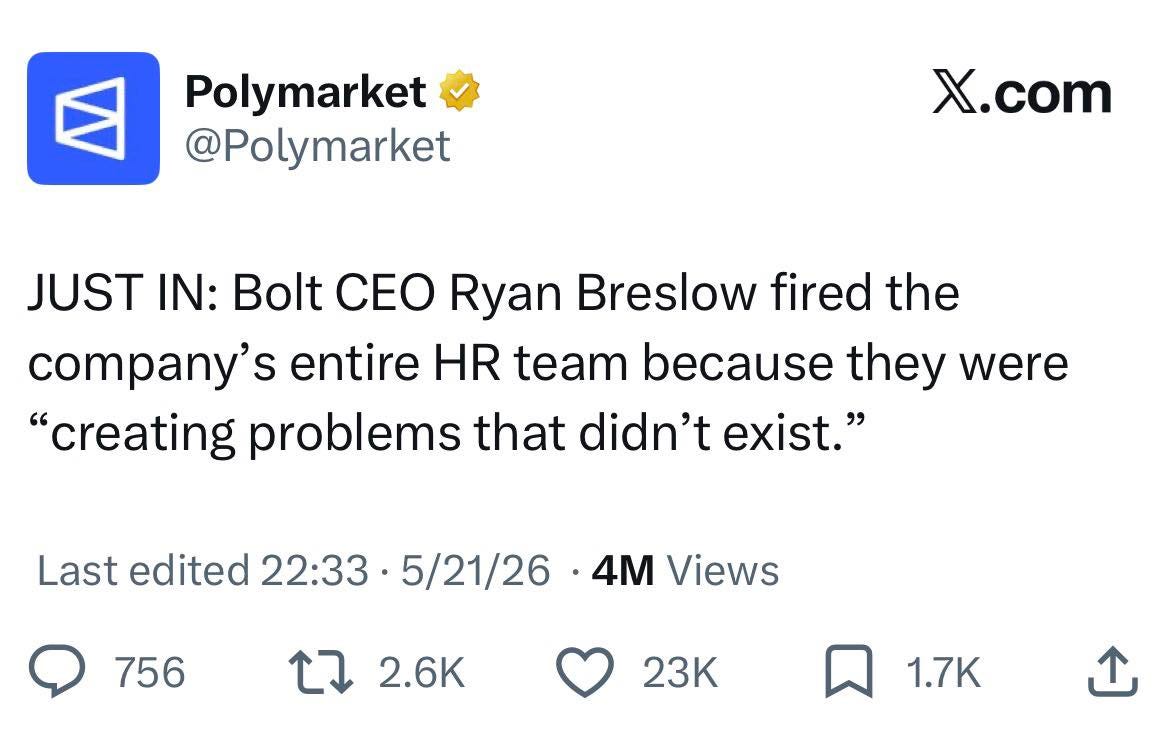
Years ago I received my sixteenth manager in roughly six years at a technology company where I had remained unusually loyal despite increasingly obvious signs of decay. The new fellow had a habit of screaming at people like some sort of deranged plantation overseer, and when I eventually brought my concerns to HR, they were unfortunately occupied collaborating with marketing on a glossy internal campaign explaining how our company culture was rare and uniquely valuable - irony of ironies.
A few months later I left for a similar role with a competitor
Edwards Deming once observed that a bad system will beat a good person every time, and the older I get the more convinced I become that he was describing one of the fundamental pathologies of modern civilization.
The issue is not merely corruption, though corruption certainly exists.
The issue is that organizations gradually accumulate entire ecosystems of internal structures which become increasingly detached from the economic and operational realities sustaining the organization itself.
At Xerox, where I spent years working during a particularly transitional era in the printing industry, there were entire bureaucratic kingdoms still calibrated to assumptions that had made sense sometime around 1977. The company still generated billions in revenue, but internally it increasingly resembled a sort of administrative sedimentary rock formation, layer upon layer of cost centers, approval loops, initiatives, oversight mechanisms, and procedural rituals that frequently delivered negligible value while slowing the organization to a crawl.
And the fascinating thing is that almost nobody inside such systems recognizes the drift while it is occurring because the bureaucracy itself becomes the atmosphere.
People adapt themselves to the maze as it struggles to navigate the haze
This realization did not merely emerge from corporate life, however.
As I’ve shared in prior articles, I’ve “triple-dipped” my professional and vocational endeavors, carrying lessons-learned from the military into the corporate and skateboarding domains, and vice-versa.
And so in many respects the realization began beneath a bridge in Portland while helping build Burnside Skatepark during the early 1990s, as I talk about in this article about a place called “the most famous skatepark in the world.”
Burnside was not the product of institutional planning.
It emerged because skaters, many of them broke kids with rough edges and questionable judgment, simply began building a thing the city had failed to provide.
Over time the project developed a strange sort of legitimacy because it worked. Crime diminished. Community emerged.
The city eventually formalized what had originally been an illegal DIY endeavor carried forward largely through stewardship, sweat equity, and shared norms rather than administrative authority, and it’s stewarded thus today, over 36 years later, often by adults who weren’t even alive when we broke ground on a renegade DIY project located in what used to be one of Portland’s dirtiest and most dangerous places.

You cannot argue with undeniable results
That experience left a permanent mark on me because I began noticing that many functional systems emerge from stewardship first and governance second, whereas modern institutions increasingly attempt to impose governance in the absence of stewardship and then act bewildered when the system gradually fills with theater, resentment, performative compliance, and administrative self-preservation.
It might not hurt to read that part again, because it’s important.
Over the better part of the last decade I have been attempting to document some of these observations within a governance architecture I eventually titled The Seven Functions of Digital Self-Governance.
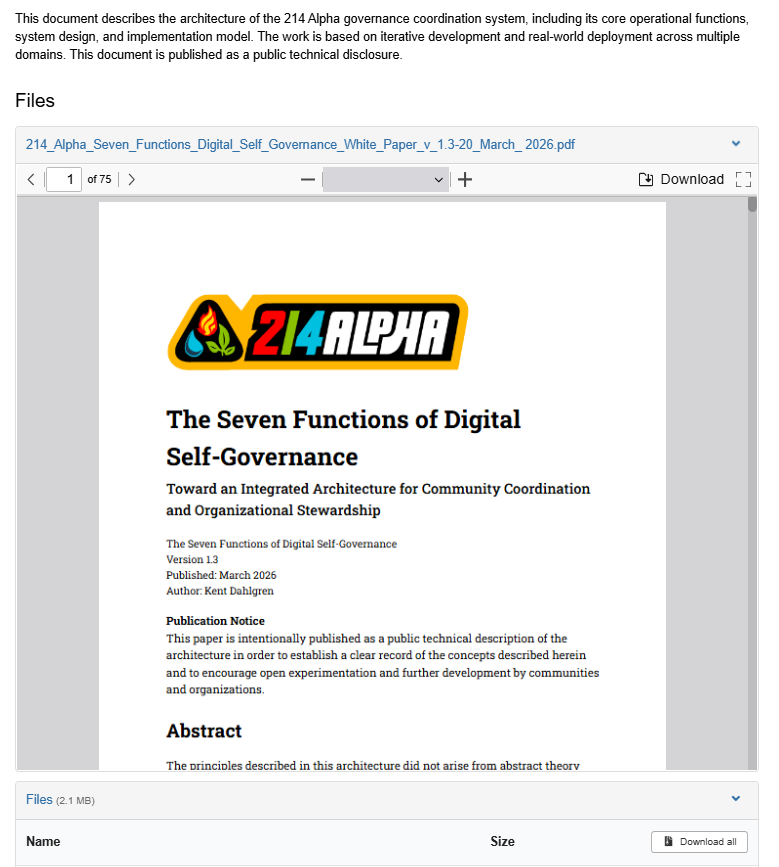
The accompanying white paper was recently published through Zenodo, with the specification archived through SSRN, though I should probably clarify that this is not one of these techno-utopian fantasies proposing that software will magically solve human nature.
It won’t.
Technology cannot manufacture stewardship where none exists
What it can do is reduce the coordination burden associated with maintaining stewardship once people decide they genuinely wish to build something together.
That distinction matters a great deal.
Increasingly I suspect that many of our institutional crises are not ideological crises so much as coordination crises. Communities struggle to govern themselves coherently. Large organizations become administratively top-heavy and operationally fragile. Governments drift too far from the realities at the last mile. Intentional communities collapse beneath unresolved asymmetries of reciprocity and accountability. Even digital platforms eventually decay into noise because they lack sufficiently coherent stewardship structures.
And because I spent years in anti-fraud systems, platform architecture, and observability tooling, my instinct was not merely to complain about these patterns, but to ask whether governance itself could become more transparent, accountable, measurable, and easy to audit before institutions drift toward collapse.
Not authoritarian, but observable.
Not replacing governments, but reducing the trust-to-collapse gap.
Not eliminating communities, but helping them coordinate more coherently at the last mile where it is needed most.
Anyway, I finally decided to publish the paper because after observing these patterns for long enough, it seemed irresponsible not to place the ideas into the commons where others could criticize, refine, reject, improve, or experiment with them themselves.
And besides, the older I get, the more convinced I become that civilization is ultimately sustained not by institutions alone, but by stewards willing to keep showing up before the thing falls apart.
This article frames my point pretty well: